
Exports from Paraguay’s maquila industry experienced significant growth of 34% year-over-year in January 2025, reaching USD 100 million. This performance consolidates the sector as one of the fundamental pillars of the country’s foreign trade. Analysis of commercial destinations reveals a marked regional concentration, with Mercosur countries absorbing 86% of total exports under this regime. To a lesser extent, other relevant markets for Paraguayan maquilas were Bolivia with 3.2%, Chile with 2.9%, and the United States with 2.7% of the total value exported during the first month of the year, demonstrating an incipient but constant diversification toward markets outside the regional bloc.
Simultaneously, imports linked to the maquila sector registered a 45% increase in year-over-year terms, totaling USD 77 million. This increase, although higher in percentage terms than export growth, did not prevent the sector’s trade balance from maintaining a positive result. Figures indicate that exports exceeded imports by 29%, confirming the efficiency of the maquila model in generating added value from imported inputs. This sectoral surplus contributes positively to the country’s general trade balance and demonstrates the economic viability of the maquila regime as a strategy for industrialization and foreign exchange generation.
The territorial distribution of companies operating under the maquila regime reveals a significant concentration in certain geographical areas of the country. The Department of Alto Paraná leads this distribution with 48% of approved maquila companies, a position favored by its border location with Brazil, the main destination market within Mercosur. The Central Department ranks second with 28% of companies, followed by Asunción (Capital) with 9% and the Department of Amambay with 6%. This geographical distribution reflects the influence of logistical factors and proximity to markets in industrial location decisions, enhancing the economic development of strategic areas of the national territory.

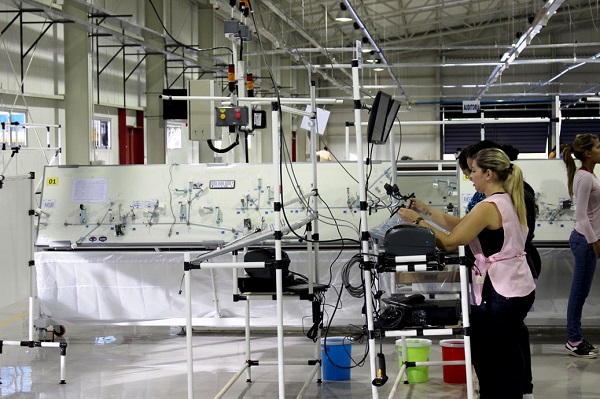
In terms of employment, the maquila sector continues to establish itself as an important generator of jobs. During January 2025, 734 new jobs were registered, raising the total to 30,690 people directly employed in activities linked to this regime. This figure represents a 22% increase compared to the same period of the previous year, demonstrating the sector’s dynamism in terms of formal job creation. The labor absorption capacity of the maquila becomes more relevant in the current economic context, contributing to social stability through the generation of job opportunities with prospects for sustained growth.
Sectoral analysis of employment distribution in the maquila industry reveals a concentration in five main areas that together represent 72% of the total workforce employed. The auto parts sector leads this distribution, followed by the clothing industry, intangible services, and plastic and chemical product manufacturing. This sectoral composition reflects the evolution of the maquila regime in Paraguay, which has managed to diversify from traditional labor-intensive activities toward sectors with greater technological components and added value. Integration into regional value chains, particularly in Mercosur’s automotive sector, has allowed the development of specialized production capabilities in the country.
Follow us on Instagram.
The positive evolution of the Paraguayan maquila sector during the first month of 2025 confirms the effectiveness of this regime as an instrument of industrial and commercial policy. Growth in exports, job creation, and maintenance of a favorable trade balance demonstrate that the model has managed to adapt to regional and global market conditions. However, the high concentration of exports to Mercosur presents challenges in terms of market diversification to reduce vulnerabilities to economic fluctuations in neighboring countries. In this context, the marginal increase in exports to markets such as the United States, Bolivia, and Chile represents a positive trend that could be strengthened through trade agreements and promotion strategies that facilitate access to new destinations for products manufactured under the Paraguayan maquila regime.
Artículo en español aquí.